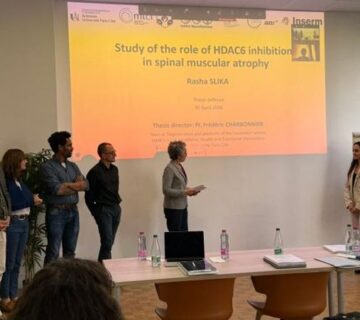
Partners of the RHU SMART consortium show that HDAC6 inhibition could represent a valuable additional SMN-independent therapeutic strategy to restore muscle function in SMA.
More details here: https://academic.oup.com/brain/advance-article/doi/10.1093/brain/awag148/8666440
Spinal muscular atrophy (SMA) is a severe neuromuscular disorder caused by defects in the SMN gene, leading to motor neuron degeneration and progressive muscle weakness. Without treatment, most affected children do not survive beyond the age of two.
Recent gene therapies have dramatically improved survival in SMA patients. However, treated individuals still experience persistent muscle atrophy and functional deficits, resulting in a new clinical presentation. Over the past years, studies in animal models of neuromuscular disorders have highlighted the potential of inhibitors targeting the non-conventional histone deacetylase 6 (HDAC6) to reduce muscle atrophy.
In this study, the authors investigated the impact of HDAC6 inhibition on muscle cell differentiation and evaluated in vivo whether combining HDAC6 inhibition with current standard SMA therapies could further improve muscle function and overall condition in SMA mice.
The study demonstrates that HDAC6 plays a key role in myotube formation and maturation in vitro. In particular, HDAC6 inhibition increased the size of primary myotubes derived from SMA patients. In vivo, when combined with antisense oligonucleotides (ASOs) promoting exon 7 inclusion in SMN2 RNA, systemic HDAC6 inhibition significantly improved muscle strength, muscle mass, motor function, and survival in an SMA-like mouse model.
These findings provide strong evidence that selective HDAC6 inhibition enhances myogenic progression and represents a promising therapeutic avenue to alleviate persistent symptoms in SMA patients receiving current standard-of-care treatments.
Congratulations to first author Rasha Slika (Frédéric Charbonnier’s team) and Alexis Osseni (Laurent Schaeffer’s team)!
Special thanks also to all contributors involved in this work: Laurent Coudert, Agnès Duplany, Laure Weill, Edwige Belotti, Eleni Siopi, Yann-Gaël Gangloff, Delphine Sapaly, Sabrina Bendris, Zoé Clerc, Gaëlle Bruneteau, Carole Vuillerot and Pascal Leblanc.